

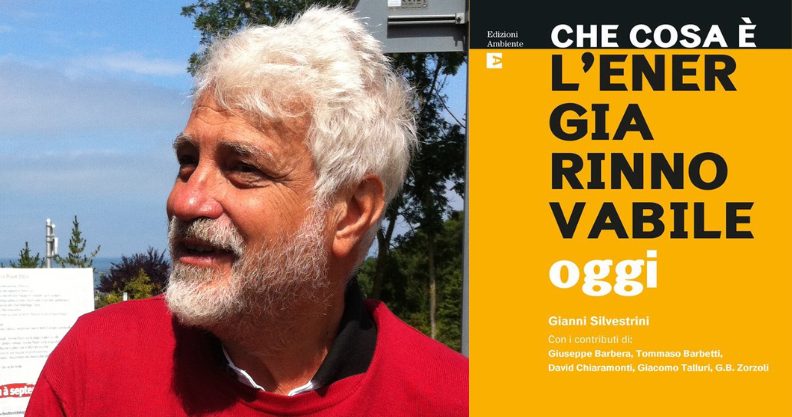
The book “What is renewable energy today” (Edizioni Ambiente – 2022) offers a complete and updated overview of renewable energy.
Written by the author Gianni Silvestrini, an expert in the sector, with contributions from David Chiaramonti, Giacomo Talluri, Tommaso Barbetti, Giuseppe Barbera and Giovanni Battista Zorzoli, the book is aimed at young people, activists, schools, associations and businesses, with the aim of providing a comprehensive tool on renewables.
Silvestrini analyses several key aspects, such as storage systems, network management, energy communities, biomass and energy efficiency. The book also highlights why focusing on fossil fuels or nuclear is not only risky, but also less economically advantageous than reducing consumption and using renewable energy. The volume provides a comprehensive and updated overview of the contribution of renewable energy to the decarbonisation of the economy and job creation.
Furthermore, it analyses the strategic role of renewables in the new international scenario, seriously compromised by the war in Ukraine, which according to the author will have more significant consequences than the Gulf crises.
The Italian situation
About ten years ago, Italy saw a strong growth in renewable energy thanks to generous but often poorly coordinated incentives. Subsequently, governments seemed to want to punish the sector, as if they had already given too much to renewables. However, this decision was not appropriate, as module prices have fallen dramatically, making it convenient for the system to focus on clean energy. Despite the increase in module prices due to the international situation, global investment in renewables continues to grow. No other technology, including nuclear, can compete with this trend. The Italian goal of reaching 72% of electricity from renewable sources by 2030 is very ambitious, but renewables are now an unstoppable train.
The motivations behind the book
Considering the current energy situation, the motivations behind this book are even more relevant. It is often asked whether the war will lead to a slowdown or an acceleration of renewable energy. In the short term, there could be a brake (such as the reopening of coal-fired power plants), but from a strategic point of view the opposite happens: Germany had set a target of 80% renewables by 2030, now, driven by the desire to reduce dependence on Russian gas, it aims for 100% by 2035. Unlike Germany, Italy has no coal reserves and imports all the gas it uses, covering over 40% of its electricity needs. Consequently, our commitment to renewables should be even stronger.
Huge potential from photovoltaics and wind
The transition to clean energy must accelerate significantly, with solar and wind as the main protagonists, together with biomass. Photovoltaics in particular has huge potential, thanks to innovative solutions such as seasonal storage and industrial use to produce heat. China remains the global leader in photovoltaic power generation, but the United States and especially Europe are expected to recover significant market shares in the next decade. However, this growth requires overcoming some challenges, such as the shortage and high prices of silicon, the insufficient use of agricultural land for solar panels, and the limited production of photovoltaic modules in Europe.
Agrivoltaics and offshore wind
Agrivoltaics and offshore wind have great potential, although they still require experimentation. Research into agrivoltaics has shown that the shading of panels can have a very positive effect on some crops, such as vines in France. With rising temperatures, agrivoltaics can be very effective in Italy and other countries. Offshore wind has already been successful in the North Sea, with costs per kWh much lower than the new nuclear power plant under construction in England. Offshore wind is also expected to play a major role in the Mediterranean over the next decade, despite the weaker winds.
Energy Communities
Another important innovation is renewable energy communities. First, renewable energy communities (CERs) promote a cultural change, increasing the level of information and understanding of citizens. So far, active CERs are small in size, created from the bottom up and with a strong social impact. Although there is a risk of limited management capacity, the opportunity lies in the involvement of businesses, which could provide capital and technical expertise to create larger and more stable energy communities. The synergy between businesses and citizens has great potential and could lead to the inclusion of entire neighborhoods or municipalities.
A path not without obstacles
Silvestrini explains that the role of renewable energy will be central in the fight against climate change, but it will not be a simple path without obstacles. Rather, it will be an obstacle course that will require intelligently addressing issues such as the landscape, regulatory and authorization aspects, as well as the difficulties of supplying critical materials. Furthermore, the profound transformation of the global energy sector will still lead to resistance from fossil fuel sectors that feel threatened. However, this path can also become an opportunity to involve local realities, arouse emotions, prefigure alternative futures and push the search for new solutions.