

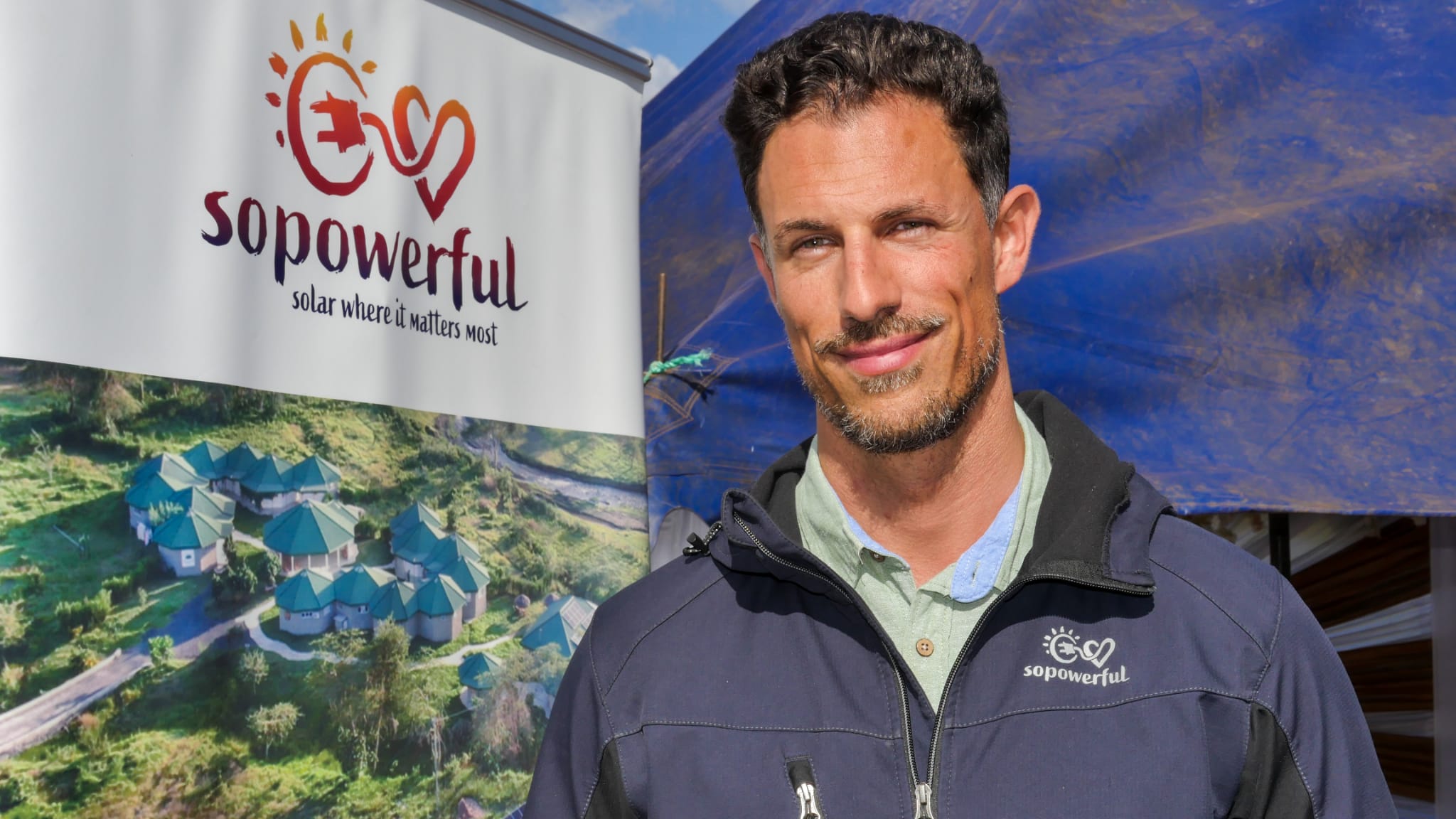
Today we meet Stefano Cruccu, Founder & Director of the Sopowerful Foundation.
You recently opened donations to private individuals: what prompted you to take this step, and what impact do you expect from more direct public involvement?
Yes, we just launched our ongoing crowdfunding campaign, called “Sunrays.” Several people had asked us if it was possible to support our projects in a more ongoing manner, rather than making occasional donations.
We believe there’s great potential: many people enjoy donating to support concrete projects where they see a tangible impact, but we’re often discouraged by a lack of transparency or by the fact that a significant portion of the donation ends up covering overhead costs. In this case, we guarantee that 100% of the donation will be used to implement a photovoltaic system “where it matters most,” and you can already participate for as little as 50 cents per day.
Some of the most significant projects have been completed in Tanzania. Can you tell us what you’ve done on the ground and what specific problems you’ve helped solve?
Aside from Malawi, we now have six projects underway in Tanzania. Our photovoltaic systems enable improved healthcare services, as well as improved educational processes in schools. The lack of power, or reliance on a weak grid, seriously limits the quality of these services, both of which are essential for development and improved quality of life.
The Sopowerful local team has grown significantly: how is it structured today and what role does it play in the day-to-day management of projects?
Our colleagues in Malawi and Tanzania play a key role, both in project selection and implementation, as well as during the operational phase and impact monitoring. Having reliable local people, a deep understanding of the culture and challenges, and the ability to communicate in the local language are essential and not a given. I must say that I am very proud to work with such a diverse and multicultural team, whose experience and skills grow every day.
Looking at the communities involved, what are the most tangible changes you’ve observed in people’s lives thanks to access to energy and technology?
If we talk about projects where photovoltaics enable irrigation, on average, food insecurity has decreased by 30%, resulting in communities being classified as “moderately food insecure” rather than “severely food insecure.” For projects where photovoltaics power electric pumps, we see significantly fewer illnesses caused by polluted water and, for example, a distance to the tap that is on average 80% shorter than before the project. Some people save countless hours a day, not having to make superhuman efforts to get it. Where photovoltaics enable better education, for example, we see almost 30% more students passing their exams. Where we implement solar systems for clinics and hospitals, it truly changes the reality for so many people: from someone who comes in late at night and finds their medications requiring refrigeration (“cold chain”), to the person undergoing life-saving surgery who is now no longer impacted by the power outage.
Looking at the communities involved, what are the most tangible changes you’ve observed in people’s lives thanks to access to energy and technology?
If we talk about projects where photovoltaics enable irrigation, on average, food insecurity has decreased by 30%, resulting in communities being classified as “moderately food insecure” rather than “severely food insecure.” For projects where photovoltaics power electric pumps, we see significantly fewer illnesses caused by polluted water and, for example, a distance to the tap that is on average 80% shorter than before the project. Some people save countless hours a day, not having to make superhuman efforts to get it. Where photovoltaics enable better education, for example, we see almost 30% more students passing their exams. Where we implement solar systems for clinics and hospitals, it truly changes the reality for so many people: from someone who comes in late at night and finds their medications requiring refrigeration (“cold chain”), to the person undergoing life-saving surgery who is now no longer impacted by the power outage.