

Solar Quality Summit Europe: Raptech present!
Raptech is one of the partners of Trust-PV, a four-year research project funded with over 12 million euros by the European Union’s Horizon 2020 programme. TRUST-PV will improve the performance and reliability of PV systems by supporting the development of O&M-compatible and grid-friendly PV components and solutions across broad portfolios of distributed and utility-scale systems.
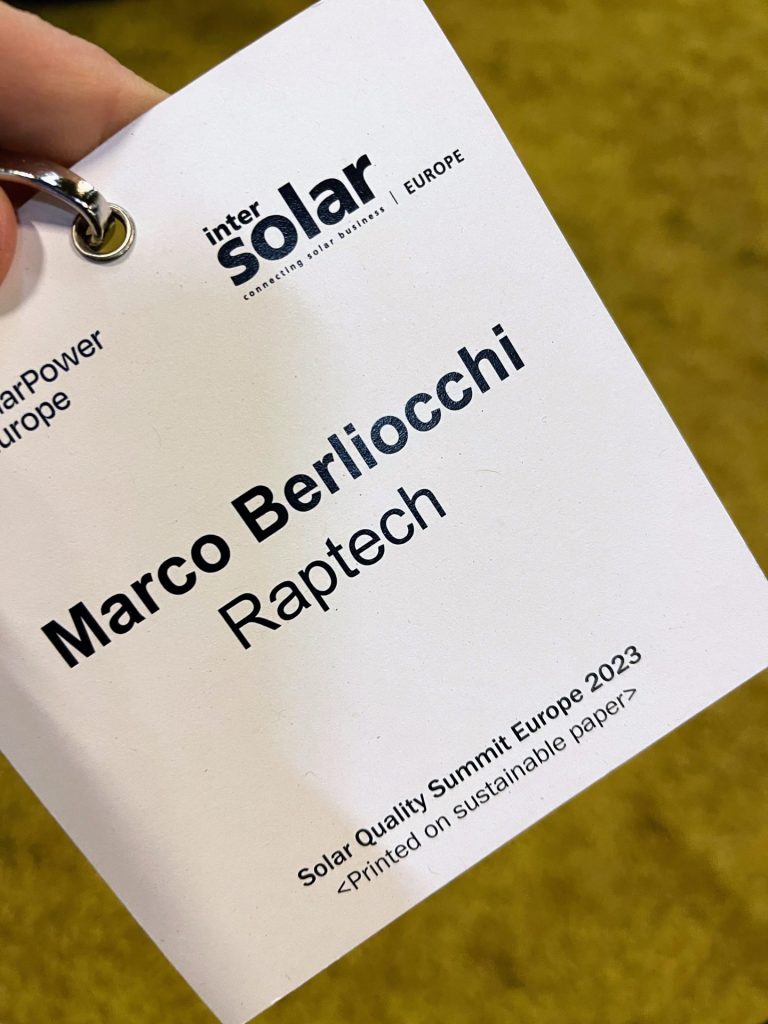
As part of the project, Raptech participated in Solar Quality Summit Europe in Barcelona (January 24-25), which brought together all stakeholders in solar quality management, including investors, service providers and technology providers, to provide them an overview of the latest market developments, sharing best practices in EPC, O&M and Asset Management, exploring challenges, and discovering emerging technologies and trends.
Below we report information, data and considerations that emerged during the two days of conferences.

Quality vs quantity: overcoming the binary approach
The European market is booming, it is a mature market that requires quality and such rapid growth certainly represents a challenge. Quality should not be seen in a Manichaean and binary context in contrast to “quantity”.
Let’s see how.
Not only technical skills, not only engineers but also financial and digital skills are needed to contribute to the energy transition, but there is a basic shortage to counter which we also need people from other sectors without solar experience to be trained within companies .
As far as the issue of component shortage is concerned, it is clear that today some components have to wait up to a year; a large percentage of module production in China has been delayed; The COVID problem has delayed many projects; The US has banned Huawei, the largest inverter maker, and that’s another problem. Careful procurement management has therefore become crucial from the point of view of development and construction.
All the players agree that making quality has a low marginal cost. The important thing is to look at the solar ecosystem in a complete way and not just at a small part of the value chain, in doing so the quality will not present such high costs.

The European markets with the highest potential
Thanks to the data from Solar Power Europe, it was also possible to get an overview of the growth potential of the various European countries.
With 41.4 GW installed in the EU in 2022, this marks the best solar year in European history so far, 47% more than the 28.1 GW installed in 2021, when an old record was broken ten years old.
As in the previous year, Germany is still the largest solar market in Europe in 2022. Among the top 10 are 2 newcomers (Portugal and Sweden).
In 2022, the EU’s solar power generation park increased by 25% to 208.9 GW, up from 167.5 GW in 2021.
When it comes to solar energy per capita, the Netherlands leads Europe ahead of Germany and Denmark.
The next 4 years, up to 2026, will see further strong growth, with an annual solar market of almost 54 GW already in 2023 and reaching 85 GW in 2026 (EU27 Annual solar PV Market Scenarios 2023-2026).
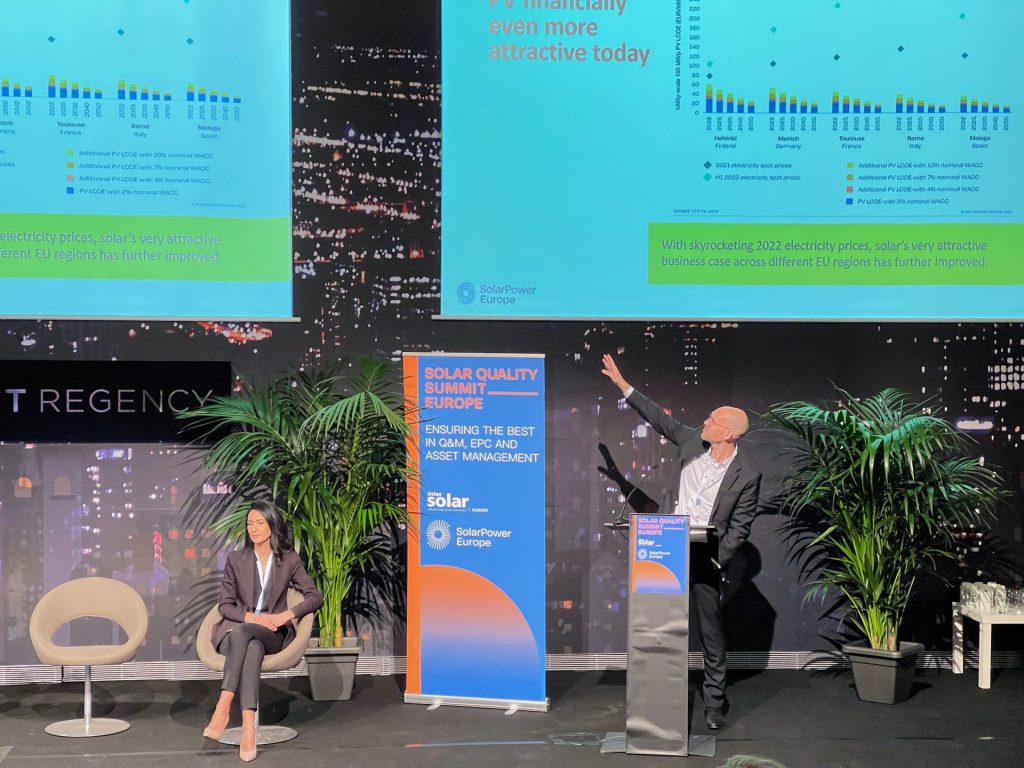
The greatest growth in the coming years will be seen in emerging markets in the EU as Germany reaches double-digit GW levels for the first time in 2023 and nearly doubles installations to around 20 GW in 2026.
Large-scale solar will remain the main driver for solar in Spain, but the rooftop segment will also have a sizeable market share.
The Italian solar market is expanding mainly thanks to tax incentives for the rooftop segment, which is expected to be the main basis for solar growth.
While complicated regulations have slowed solar in France, several legislative measures are expected to lead to double-digit annual growth rates over the next few years.
Three quarters of EU member states will have already met the 2030 National Energy Plan for the Climate (NECP) solar target by 2025. Total EU solar energy is projected to rise from 209 GW installed today at 399 GW in 2025 and 920 GW in 2030.
The market for clean technologies by 2030 will be worth 650 billion euros (IEA).